
This place called Spain
tinned fish, tomato bread, and bathing suits at the nude beach

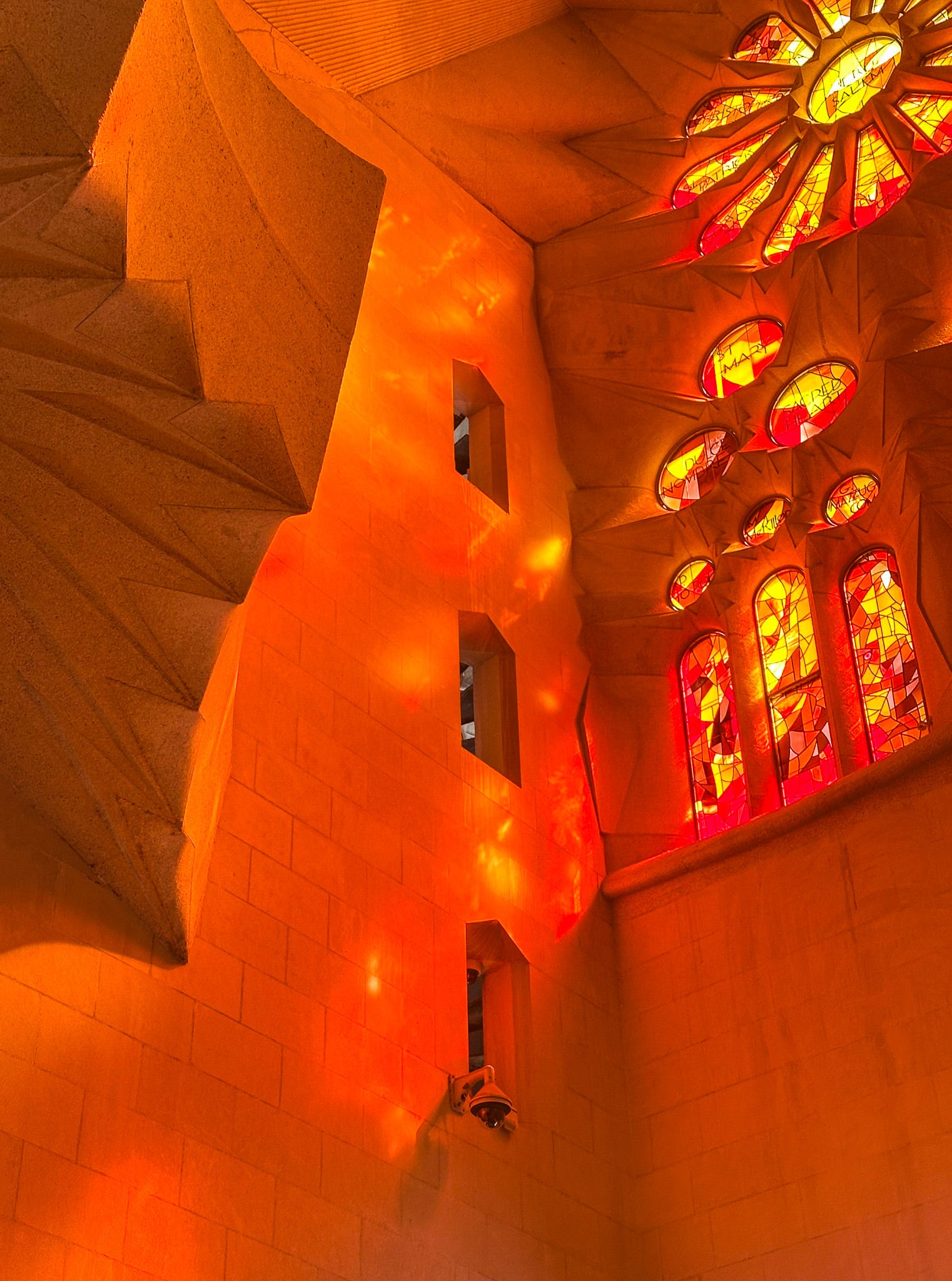
I called my dad last Saturday morning while I was out walking with my dog, Dottie. As I crunched along the path through the park, he told me that he had woken up early, as he often does, and expected to see my newsletter there in his inbox. “It felt a little lonely,” he said, “not seeing it there.” I took a week off while I was away, I explained, but that didn’t soothe a dad who was up early, looking for a story. The following day was father’s day, and I woke up feeling the urge to whip off a quick story, a little gift to him to fill the gap, sent off schedule, a surprise.
I would tell him about our visit to Gaudí’s Sagrada Familia on our first day in Barcelona. We arrived in the late afternoon and Barcelona felt soft, like it was just waking up from a nap. The air had lost its searing heat, and the tone of the city was calm on the cusp of the nighttime thrum. We joined the clusters of tourist (14,000 on that day alone) plugged into audio tours looking upwards, sideways and all around, trying to decide where to fix our eyes. I settled in the western corner, drawn by the stained glass casting a kaleidoscope of red, yellow and orange across the shapes and surfaces below and high above me. I spinned beneath the glow, my head facing the ceiling, my body almost touching those around me, my mouth agape. Did Gaudí know that one day the only empty space in this city would be 150 feet above the tourists? Is that why he fashioned a vaulted ceiling into a canopy of colourful trees, so we could look up with wonder?
I would tell him this because my dad loves the notion of wonder. He is a curious person. He is moved by beauty, music, books, flowers, and the birds at his bird feeder. This moment when awe strikes - whether in La Sagrada Familia or at the bird feeder - makes me think of the artist Mary Pratt, who didn’t call this feeling wonder, she called it an erotic charge. Pratt settled in Newfoundland with her artist husband in 1961 and had four children by 1964. She was the caregiver of the children, the homemaker. Her studio time was limited. But when she saw something in her domestic life that filled her with passion, love and desire - jam jars glistening in the light, scaly fish in the sink, a bowl of cherries - she took a picture and sent the film to Toronto to be developed. Three months later, when the film came back to her home in Newfoundland as slides, she viewed the images through a light box in the hopes that she would remember that initial jab of enthusiasm that compelled her to take the image in the first place. And when this happened, after the children were asleep, she painted. It was a love affair with vision, she once said in an interview with the National Gallery of Canada. And once that love affair began she said, “all of the windows and doors opened and there were images everywhere that ground themselves into me.”
I would tell him how the light of the Sagrada Familia opened all the doors and windows in me for the rest of the trip. That love affair was even in Pan con Tomate, the tomato bread we ate at every meal in Barcelona. The recipe is simple: bread, sliced tomato, sliced garlic, sea salt and olive oil, but each restaurant serves it in their own unique way. Sometimes toasted bread arrived with sliced garlic and tomatoes, and we were invited to rub the garlic and cut tomato across the textured surface of the toast. Sometimes it arrived already dressed with garlic, a thin layer of tomato pulp with a swirl of olive oil and a hint of sea salt. One time the bread arrived soft, untoasted, already dressed. And towards the end of the trip the garlicky tomato pulp was served on thin, rustic crackers. We used every last bit of cracker to scoop up a green salad of thinly sliced avocado, soft herbs and harissa.
I would tell him about the corner store we stumbled upon on our last night in Barcelona filled with wine, cheese and tinned fish. We were in front of the store facing the other side of the street, looking up, way up, as is the way when photographing one of the many whimsical Gaudí-inspired apartment buildings of Barcelona. But then I noticed what was behind us - a soft pink stuccoed building with sculpted corbels supporting elaborate balconies - a neoclassical style I’d later learn was a reaction to Gaudí’s modernism. Beneath the balconies on the ground floor was a beautiful old corner store with a post-it note on the door that read, €5 to come in and only look. I imagined the owners of this shop, working here on this corner since 1926 as tourists gawk and stare at the neighbouring buildings and treat their shop as a museum. So I pushed open the glass door, heard a bell chime, and said hola to the man in a brown uniform behind the counter. A debonair gentleman sat perched on a stool at a white marble counter, quietly sipping a glass of cava, one blue espadrille resting on the encaustic tiled floor. Colourful tins of fish were stacked on wooden shelves in front of me, so many colours, so many varieties, accessible by opening small glass fronted doors. I would tell my dad how I opened one of the doors and selected a can of sardines for him, inspired by the CBC article he sent me a few weeks before about the rise in popularity of tinned sardines. The subtitle read, “What was once grandpa food is now considered affordable luxury.”1 I thought about how sardines were ruined for someone like me who grew up watching Oscar the Grouch on Sesame Street flinging sardine skeletons from the dregs of his home, a garbage can. But then I remembered the sizzling plate of sardines we devoured at a beachside restaurant a few days before in Sitges just south of Barcelona, spooning them over garlicky tomato bread with sea salt and olive oil, and knew I had shifted over the years, I had grown up. So I bought a few cans of sardines2 that day, swept away by the beauty of the store and the gentlemanly luxury of it all, and flew home with them wedged between my sandals and bathing suit.
I would even tell my dad about our swim in Sitges after our meal of sardines and tomato bread. We arrived in the middle of Gay Pride festivities. Bodies filled the town dressed in drag, dressed in costumes, in leis around necks, wigs on heads, chains dripping on hairy chests, pleather shorts on tight butts and cigarettes between fingers. It was 30C. By five pm we - a group of five women, all over 50 - were stretched out in bathing suits on the beach, contemplating a swim. I would tell him this because he doesn’t know the beauty of being this age, this gender, on a beach full of naked men. We were completely free, safe, and best of all, invisible. Men of all shapes and sizes cruised by as we discussed our lives, our thoughts on religion, the catholic church and Spanish art, all while eating chips and sipping agua con gas. I was in awe, in wonder, of how the nudity slipped away, how it became part of the background of this place called Spain.
I would tell him all these things, quickly, before the day began, because I had jet lag on my side and stories in my head. But then Dottie wanted to go for a walk, and the irises in my backyard needed admiring, and the booming voices from SailGP echoed off the harbour and drifted up Morris Street calling me to come and watch, and laundry, so much laundry, needed doing, and before I knew it, the day was gone.
Los Peperetes are on the menu tonight served on garlic-rubbed toast with avocado and sea salt.
I would like to add a photo here of a tinned fish shop in Les Sables d’Olonne on the French Bay of Biscay. Alas, technology has me confounded.
I will instead tell that one of my favourite snacks is sardines in tomato sauce served on rye crispbread. The soft fish goes so well with the strong crunchy cracker which is thick enough to not get soggy with the tomato sauce. I think my
body tells me I need the omega 3s and the calcium from the fishbones.
..stirring up beautiful memories.
The architecture, food, art and the people♥️